
How accurate are TrackStat's split times? Measured against timing gates
Standard vs Precision timing, head-to-head with dual-beam timing gates: how much error there is against the gates, rep to rep, and the smallest change you can trust — across 82 flying 10 m reps from 16 athletes.
Timing gates are the standard way to time a sprint, and they’re what coaches hold every other tool up against. So the obvious question for a camera-based tool: how much error is there in a split time pulled off video?
To find out, TrackStat was run head-to-head against dual-beam timing gates — the more dependable kind, which only trigger when the body breaks both beams — timing the same reps at the same time. Two versions of TrackStat’s split timing were compared:
- Standard timing — how TrackStat times splits in the app today.
- Precision timing — an upgrade coming to TrackStat that gets more out of the video, including, on a GoPro, the camera’s own built-in sensor data.
The setup
Sixteen athletes ran flying 10 m reps through a pair of dual-beam gates, set 10 m apart with a tape. Every rep was filmed side-on with a GoPro at 240 frames per second, calibrated with cones on both lane lines, and timed with TrackStat’s split detection, checked by the coach. 82 reps in total, from 0.94 s to 1.43 s.
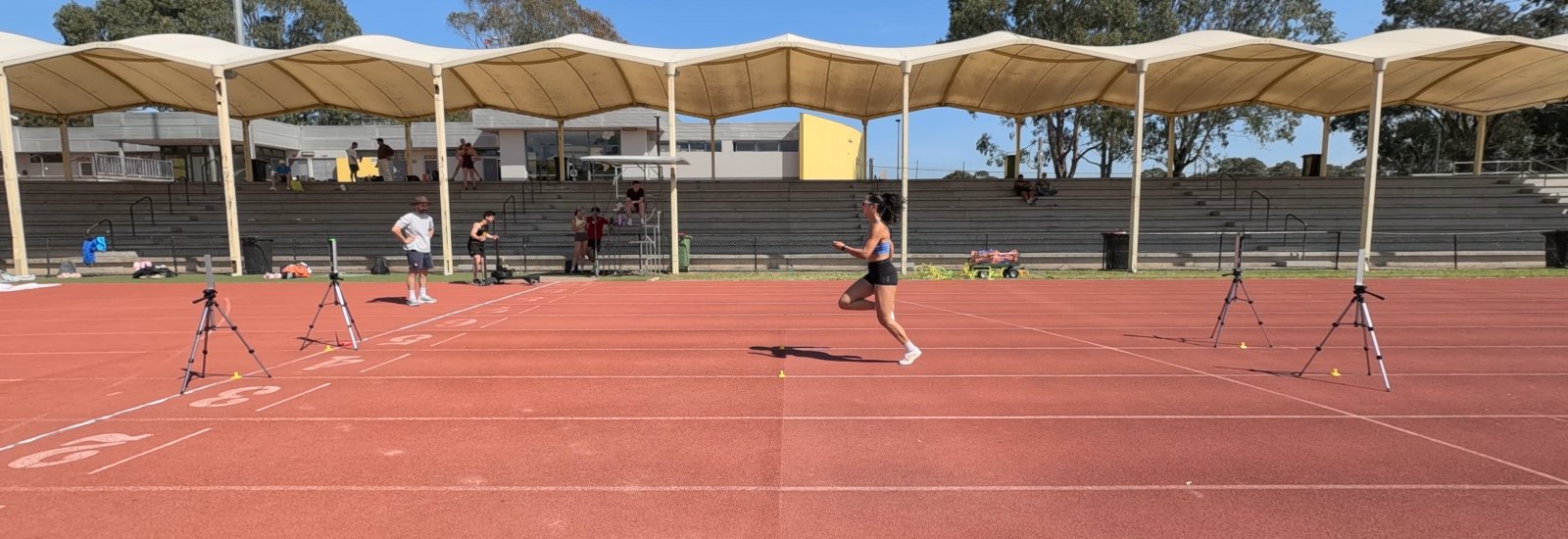
The 10 m zone — dual-beam gates at each end, cones on both lane lines, filmed side-on for TrackStat.
The result
Timing gates: 0.008 s
Timing gates: 0.022 s
Difference per rep — TrackStat minus the gates, against each rep’s gate time. Grey: Standard timing. Red: Precision timing.
What the numbers mean:
- Typical error vs the gates — how far TrackStat’s time usually sits from the gates’ time on any one rep.
- Rep-to-rep error (SEM) — how much the same athlete’s best reps vary from one to the next, measured by each system on its own. Athletes genuinely vary a little rep to rep, so even the gates don’t score zero; their figure is the floor.
- Smallest real change — how big a difference between two reps has to be before it’s more than measurement error.
Precision timing halves the typical error against the gates, from 0.015 s to 0.008 s (0.7% of the time), and brings the rep-to-rep error almost level with the gates’ own (0.009 s vs 0.008 s), with no tendency to read fast or slow (average difference −0.001 s). For a coach, that means a change of about 0.026 s between two reps is a real change — the gates themselves need 0.022 s.
Even the gold standards disagree
Timing gates are a reference, not the truth. In published research (Journal of Strength and Conditioning Research, 2025), a 1000 Hz laser and dual-beam timing gates — the two gold standards coaches already trust — timed the same 10 m splits about 0.03 s apart, with 95% limits of agreement of roughly ±0.03–0.04 s (see the GPS case study). Precision timing’s 95% limits against the gates in this session were −0.017 to +0.015 s. These split times came from a single camera on a tripod.
The numbers
| Measure | Standard timing | Precision timing |
|---|---|---|
| Average 10 m time (gates: 1.114 s) | 1.109 s | 1.113 s |
| Average difference from the gates | −0.006 s | −0.001 s |
| Typical error vs the gates | 0.015 s (1.3%) | 0.008 s (0.7%) |
| 95% limits of agreement | −0.041 to +0.028 s | −0.017 to +0.015 s |
| Rep-to-rep error, SEM (gates: 0.008 s) | 0.014 s | 0.009 s |
| Smallest real change between two reps (gates: 0.022 s) | 0.039 s | 0.026 s |
| Correlation with the gates | r = 0.99 | r = 0.998 |
Typical error = standard error of the estimate. Rep-to-rep error and smallest real change come from each athlete’s three fastest reps (15 athletes); smallest real change = 1.96 × √2 × SEM. Limits of agreement are from a mixed model that accounts for repeated reps by the same athlete.
Caveats
This is one session at one track with one camera setup — flying 10 m reps only, filmed with a GoPro at 240 fps. Precision timing was developed using this session, so it’s now being confirmed on new sessions before it ships; these numbers will be updated as those results come in. It’s an encouraging first look, not a peer-reviewed validation study, and it’s presented as exactly that. Anyone with timing gates is welcome to run their own comparison.